Sunday, April 21, 2013

First Steam Locomotive in Canada


Wikipedia

Conflicting pictures of Canada's first locomotive. The first shows a 2-4-2 wheel arrangement, the second an 0-4-0. Turns out the second is correct, and I can't find an explanation for the incorrect painting. There was a second locomotive acquired soon after, but it was different again, with a 4-2-0 wheel arrangement. We'll put it down to artistic license. 
Clues to the puzzle found on the railway bonds where the locomotive appears to be an 0-4-0.

 And on a recent commemorative stamp from Canada Post...

 And finally a photo of the Dorchester replica at the Delson Railway Museum.


From 1837-1847 the Champlain and St. Lawrence was the sole steam railway in British North America. Running 16 miles from La Prairie on the St. Lawrence to St Johns on the Richelieu river, it provided a route from Montreal to Lake Champlain on the way to New York. Construction was begun in 1835, and the road opened for traffic in July 1836. At first horses were used for power, but the proprietors (including John Molson again) purchased an engine from Robert Stephenson in England for £1,500 and the Dorchester arrived at Molson’s Wharf in Montreal in June 1836. This was Stephenson`s 127th locomotive, it was 13 ft 6" in length, had four driving wheels 48" in diameter and weighed 12,544 pounds, .
The locomotive had a high centre of gravity and the short wheel base earned it the nickname Kitten for its skittish behavior. It arrived with its own engineer, who apparently immediately bolted, leaving the new owners to figure out this new fangled concept of steam. During the initial attempts at operation it is said that due to inexperience and small water capacity the boiler was run short of water, causing the flue tubes to rupture. 
When the locomotive was repaired and the train was finally slated for its first run, the management decided to make the trial run by moonlight. Even then, in spite of all the efforts of engineer and officials, the locomotive would not budge an inch. Finally an engineer, borrowed from the Baltimore and Ohio Railroad, reported that all that was needed was "more wood and water." and given these the Kitten gambolled along at twenty miles an hour.
 Another article mentioned that during operations in the next year or two it was found that the leading truck of the second locomotive (named the Jason C. Pierce) gave superior tracking compared to the 0-4-0 arrangement so the Dorchester was converted to the same wheel arrangement in 1839, by substituting a leading truck for its forward pair of drivers. That still doesn't match the first painting. Or this photograph.


 Contemporary railfan reports found here.

More info at The Railway Builders


Petroleum oil: when you just can't go

Reader's Digest Association (Canada) Ltd.,  In Search of Canada.  Montreal, 1971.

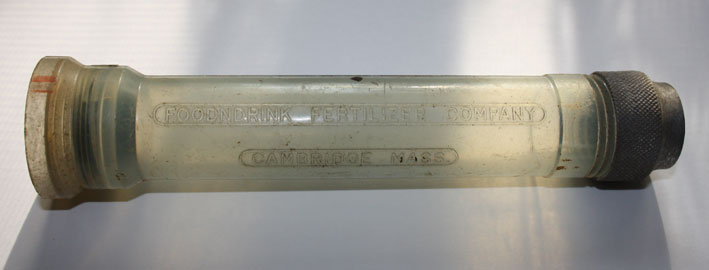
Foodndrink Fertilizer Company, Cambridge Massachusetts

This unidentified part turned up several years ago:


Aside from the fact that it must have been part of something that administered fertilizer, it remains as much a mystery as the company that produced it.

I've since donated it to Farmtown Park, the agricultural museum in Stirling, Ontario.

Sidecar Sunday


Saturday, April 20, 2013

1969 Velocette Endurance


The dog days of London

Canada 1964.  The Official Handbook of Present Conditions and Recent Progress.  Ottawa.
The series aired from 1963 to 1965.  For more info, see the Wikipedia entry.

Canada-US Trade Reciprocity in Cartoons

Richard S. Lambert.  The Twentieth Century Canada Britain USA.  Toronto:  The House of Grant (Canada) Ltd., 1960. 
Sid Barron.  The (Le) Barron Book with Puddytat Centrefold, Toronto Star, 1972.
Richard Lambert (1894-1981) was a British, Oxford-educated broadcaster and historian who emigrated to Canada to eventually become Supervisor of School Broadcasts with the Canadian Broadcasting Corporation.  Sid Barron (1917-2006) was a Canadian editorial cartoonist whose worked appeared frequently in several newspapers, particularly the Toronto Star.  The cartoons, sixty years apart, convey the same concerns.

"Trans-nationals" often involved American firms setting up subsidiaries in Canada.  See an earlier post.  The business model also involved American firms buying Canadian firms and eventually shutting them down because they were unprofitable or simply to reduce competition, the most recent example being the closing by  Caterpillar of the locomotive plant in London, Ontario it had bought only three years before.   With  the evolution of "multi-nationals" the same thing has now been happening in the United States, with factories of established American firms being closed down in favour of off-shore production.  Just about everything now says "Made in China."  Sadly, brand names which had earned a reputation for excellence  are now put on items of much poorer quality.  

Friday, April 19, 2013

Crash landing near Cobourg, 1951


“Buffeted across Lake Ontario by the worst storm in the pilot’s memory, its radio mast shattered, its wings sheathed in ice, fuel dangerously low and one engine disabled, a fully loaded American airliner crash landed this morning in the knee deep snow of a farmer’s field half a mile west of here.”

"None of its 44 passengers or three crew members was even jolted when pilot set down this U.S. airliner in forced landing on farm field near Cobourg yesterday. Propeller blades were bent."

local newspaper reports, December 21, 1951

 On January 10, 1952, before a crowd of about 500 curious spectators and reporters, with its engines at full throttle, the airliner raced along the snow-packed makeshift runway, inched over the frozen plow ridge at the end of the field and finally lifted off for the Trenton airbase for further repairs.
The Cobourg airplane crash in Christmas 1951 rivals the Gimli glider crash of 1983, and the Hudson River crash of 2009 as a rare, good news plane disaster story. Just right for Ontario’s “feel good” town.
http://watershedmagazine.com/?p=2072
http://www.cobourghistory.ca/stories/plane-landing-in-cobourg-1951

The airplane back in service a year later.