Thursday, July 5, 2012

The Maginot Line

The World Book Encyclopedia.  Field Enterprises Educational Corporation, 1970
Richard S. Lambert.  The Twentieth Century Canada Britain USA.  Toronto:  The House of Grant (Canada) Ltd., 1960.  Lambert was Oxford educated, "Supervisor of School Broadcasts, Canadian Broadcasting Corporation"
    
Lt. Col. Eddy Bauer,  Illustrated World War II Encyclopedia.  H.S. Stuttman Inc., 1972, 1979.
"Above, a platoon of British troops marches into one of the fortresses of the Maginot Line on November 3, 1939.  British brigades served with French units in the Maginot Line largely so that the troops could learn to cooperate with each other efficiently."

Below, a fortress in the Alps, on Swiss soil facing the Italian border.

Lt. Col. Eddy Bauer,  Illustrated World War II Encyclopedia.  H.S. Stuttman Inc., 1972, 1979.

Heileman's Old Style Beer


A promotional item someone gave to me years ago.  The G. Heileman Brewing Company was started in La Crosse, Wisconsin in 1858 and introduced their premium "Old Style" label in 1902.   After a period of turbulent expansion in the 1970's and its purchase by shaky Australian interests, the firm was eventually bought by Stroh's in 1996.  The name has now vanished from the market.

BSA Gold Star

Wednesday, July 4, 2012

55 HP Deutz Locomotive- from a 1954 Brochure


The Wrights on a Rolls

Laurence Meynell.  Rolls:  Man of Speed.  A life of Charles Stewart Rolls and some account of the early days of Motoring and Flying.  London:  The Bodley Head, 1953

The Cookery

D.M.L. Farr, J.S. Moir, S.R. Mealing.  Two Democracies.  Toronto:  Ryerson Press, 1963

Monday, July 2, 2012

Real American Steel


I know the Harley folk despise the AMF era but the bicycle is pretty cool!

Kenzo Tada, IOM racer

From Cycle World Nov. 1967. The date appears to be wrong.


In Kenzo Tadas own words- from a 1972 interview...
 I began as a bicycle racer, and started that at the end of the Russo-Japanese War, in 1905. That first race was once around Shinobazu pond in Ueno Park, Tokyo, which was a 3 mile course, as the pond was bigger at that time. I was 18 years old and the prize was half a dozen beer glasses... Afterwards I trained for the Komiyama race as an apprentice, like a young sumo wrestler. I rode bicycles imported from America by the Ishikawa company in Yokohama. I joined their racing team in 1907. The pace car at that race was a Triumph motorcycle. Most bicycles were imported then and the Ishikawa company brought in American Pierce and British Triumph bicycles... I rode in a 250 mile bicycle race on 30 June 1907 and I won... In those days various stages of the race were reported by telegram to the finish line. I won several races after that and was reported on widely in the press. I was paid 3 yen per month by the Ishikawa company and I raced 3, 5 and 10 mile races. 10 miles races were the main event and if I won I was paid 10 yen and 5 yen for shorter races. I moved up to racing motorcyels in about 1921. In the the Taisho era I went to see the races at the Nakayama racecourse. I bought a Triumph motorcycle which cost about a 1000 to 1200 yen whereas a bicycle was only 120 to 170 yen.  I managed a bicycle shop then whch made its own brand, Mates (as in "friends"), and sold it there on the premises. Later this brand became Shinbashi Bicycles. I raced again in 1924 but I got no prize money in that amateur race, only a trophy. At that time there were only about 20 motorcyle racers in the whole country.
  I read three British motorcycle magazines all the time, Motorcycle, Cycling and Motorcycling and therein learned about the Isle of Man TT (Tourist Trophy) race. That was the age of ships, not of airplanes so I went to Korea, Harbin and then travelled to Europe by rail in the spring of 1930. From Paris I went to Dover and it took about 40 days in all to reach Man in May. I practised for a month for the race which was scheduled for June. I rode a British 350 Velocette motorcycle on the 420 km asphalt course. A racer on a Norton came in first place that year while I finished 15th and received a trophy... I had some western clothes but at the prize reception photo shoot I wore a Japanese  haori (half coat), hakama (traditional loose fitting trousers), white tabi (socks) and felt zori (sandals). I went home via the Mediterranean sea, through the Suez canal to Singapore and then to Hong Kong before arriving home in Japan after a 41 day trip. Mine was the first overseas racing expedition to be completed and it it linked the racing community of Japan with the rest of the racing world.
 From Japan's Motorcycle Wars by Jeffery Alexander, published by the UBC Press 2008

 and more info here.


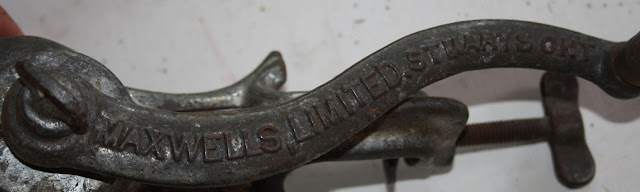
We used to make things in this country. #78: Maxwells Ltd., St. Marys Ontario

Found this yesterday in a free pile at the end of someone's driveway.  (Having a barn means never having to say "no"!)  Maxwell Ltd. No. 2 Diamond Food Chopper.


Who wrote the copy below?!!  From a time when you just described what your product would do.


All the parts are still there, along with the original pasteboard box!


Below, assembled:


I can personally attest to the fact that it does a terrific job of turning apple chunks into applesauce, much better than my British-made Spong.

Below, an older Maxwells No. 15 I picked up somewhere else:


Maxwells Limited was a foundry first established in Paris, Ontario in the late 1800's.  The business moved to St. Marys Ontario in 1888, where it became known as David Maxwell & Sons or simply Maxwell & Sons.  In its heyday, it employed over 100 people and was the largest factory in Perth County.  The two-storey building was 250 feet long, with another wing 200 feet long. The first floor was for machine work with storage in the wing and basement. Painting and finishing were done on the second floor. Three shorter wings, each 150 feet long, contained a wood shop, blacksmith shop and moulding shop. Initially, farm equipment was the main focus, but eventually it produced plows, harrows, scufflers, binders, hay mowers, tedders, sulky rakes, hay loaders, root cutters, corn shellers, ringer washing machines, lawn mowers, food grinders and churns.  During World War II, production was devoted to the manufacture of hand grenades.  Following the war, it was unable to compete and ceased operation in 1964.  The factory was demolished in 1987. 

Below, pictures of the factory from various sources, principally the St. Marys Museum Photo Collection.  The company even used to have its own band and yearly parade!


Above, 1890 group photo of employees of David Maxwell Company, St. Marys. The photograph is taken on the loading dock of the factory, located on James Street South. The dock was for shipping and receiving goods sent by train (the tracks are visible in the photograph.)

Above, photo showing the interior of the Maxwell factory (specifically the cooperage section). A group of male employees (including a boy) are posed together.  Somewhere between 1910-1920.


Maxwell's store and staff preparing for a parade of Maxwell's equipment, ca. 1901. Maxwell's staff can be seen sitting in the windows.

1944 photo of women inspectors of hand grenades at Maxwells during the World War II. The inspectors were government employees.