The 16 Commandments. The gospel according to South Bend.
Friday, February 27, 2015
Oldsmobile portable radio, 1965
Edward Pryor & Son Ltd., Sheffield, England
I picked these metal stamps up recently.Unfortunately the set is incomplete. They're made by Pryor of Sheffield, a company that started in 1849 as Edward Pryor & Son.
![]() |
| 1916 |
![]() |
| 1946 |
![]() |
| 1953 |
According to Sheffield History, as of 2007 the company was still family-owned. One person commented on that forum:
The Company is still up and running and lets hope it carries on for many more years. It was my daughters first job there and with any luck she will retire there. There's not many family run companies anymore , they all seem to have been took over by the giants more often American.
Below, how to use such stamps. This is taken from S.F. Krar, J.W. Oswald & J.E. St. Amand, Machine Tool Operations. (Gregg Division, McGraw-Hill Book Company, 1983).
BTW, this textbook is an excellent resource for hobby machinists like myself, with a wide variety of machine tool operations clearly described and illustrated with diagrams and photographs. All three authors had long careers in the trades before returning to teachers' college at the University of Toronto to achieve Specialist's Certificates in Machine Shop Practice. I'm pretty sure that such certification hasn't been offered for decades. I believe that high school shop classes today, where offered, are now taught by people who've simply graduated from teachers' college, with little to no previous experience in the trades. That's the result of the misguided educational policy of aiming to make every high school student graduate into a white-collar job, preferably IT. To misquote Herbert Hoover, "An Apple on every desktop and a mouse in every hand."
Below, the acknowledgements page from the book. How many of these machine and hand tool manufacturers are still around today, 30 years after the book was first published?
Thursday, February 26, 2015
Umbrella Hospital, 1870
We used to make things in this country. #177: Fisher-Price Canada, Orangeville, Ontario
Above, a 1960's-vintage "Tip Toe Turtle" pull-toy manufactured by Fisher-Price when they had a factory in Orangeville. Safety was stressed on the box: "For safety, no bead is provided on the pull string. For easier pull toy play by the very young, we suggest a knot or loop tied at the end of the string." "All colors absolutely safe, conform to American Standard Z66.1-1964 for use on surfaces which might be chewed by children."
Founded in 1930 in East Aurora, New York, the American parent company was bought by Quaker Oats in 1969 when one of the founders, Herman Fisher, retired. In 1991, the company became independent but this didn't last because it was purchased by Mattel in 1993. At some point, production moved in part to Mexico and China. (Today, 80 percent of U.S. toys are imported from China. In 2007, Fisher-Price had to recall a number of its Chinese-made toys because lead paint was discovered to have been used on them. Then, in 2010, they recalled more than 11 million tricycles, toys and high chairs over safety concerns. Not quite what the founders had in mind, methinks.) I can't find when the Canadian side of the firm began or ended, but it's certainly gone now.
This particular toy tip-toed into my life as a result of an complimentary email I sent to Michelle Hauser, who writes a humorous column which is carried in a local paper as well as in the Kingston Whig-Standard and The Globe and Mail. I'm not in the habit of sending such emails (in fact, it's the first time I've ever done so), but her writing was just so darn funny! (You can find her work online on her own website.) After a few weeks of exchanging emails, we eventually met up for a coffee in Napanee. She told me about finding Tip-Toe Turtle in some stuff that was being cleaned out of her husband's family's house. I expressed an interest in getting some photos for my blog, and was delighted to learn that her husband wanted the toy to go to a good home, and I was it! It's now in my house, and follows me everywhere I go.
Wednesday, February 25, 2015
Log boom on the Ottawa River
| Robert Legget, Ottawa Waterway, Gateway to a Continent, University of Toronto Press 1975 |
Vanished Tool Makers: Mibro Tools, Germany
Below, the few Mibro tools I've managed to turn up over the years:
I can't find any information on this German tool maker which, like Hoppe, clearly made a wide variety of tools.
I did pick up a 3/4" brad-point drill bit made by Mibro and packaged by the long defunct Beaver Lumber chain, so obviously at one point they were available through these Canadian hardware stores.
Of interest, all of the taps and most of the dies in my Mibro set are marked "Steer" and many are marked "Austria."
So, was "Mibro" a brand of "Steer" (or vice-versa) or was Mibro like Sears, a retailer that sold various tools under its own name?
There is a Canadian tool company by this name, but I don't think it's the same. All its website reports is that it has been around for more than 60 years. To its credit, that company is one of the sponsors of the Toronto Tool Library.
Since posting this, a received an email from Steve, a regular visitor, pointing out that the Mibro hacksaw frame bore a strong resemblance to his Eclipse 20T frame. So, I took a photo of the Mibro, my 20T, and another frame simply marked "Made in Sheffield" and "516":
They are indeed very similar, although the "ears" on the handle of the Mibro are sharper than on the two other frames. So, maybe there was some connection between the firms, or maybe it's just design convergence.
And finally a reader from Quebec sends these pictures of a hatchet he owns.
I can't find any information on this German tool maker which, like Hoppe, clearly made a wide variety of tools.
I did pick up a 3/4" brad-point drill bit made by Mibro and packaged by the long defunct Beaver Lumber chain, so obviously at one point they were available through these Canadian hardware stores.
Of interest, all of the taps and most of the dies in my Mibro set are marked "Steer" and many are marked "Austria."
So, was "Mibro" a brand of "Steer" (or vice-versa) or was Mibro like Sears, a retailer that sold various tools under its own name?
There is a Canadian tool company by this name, but I don't think it's the same. All its website reports is that it has been around for more than 60 years. To its credit, that company is one of the sponsors of the Toronto Tool Library.
Since posting this, a received an email from Steve, a regular visitor, pointing out that the Mibro hacksaw frame bore a strong resemblance to his Eclipse 20T frame. So, I took a photo of the Mibro, my 20T, and another frame simply marked "Made in Sheffield" and "516":
They are indeed very similar, although the "ears" on the handle of the Mibro are sharper than on the two other frames. So, maybe there was some connection between the firms, or maybe it's just design convergence.
And finally a reader from Quebec sends these pictures of a hatchet he owns.
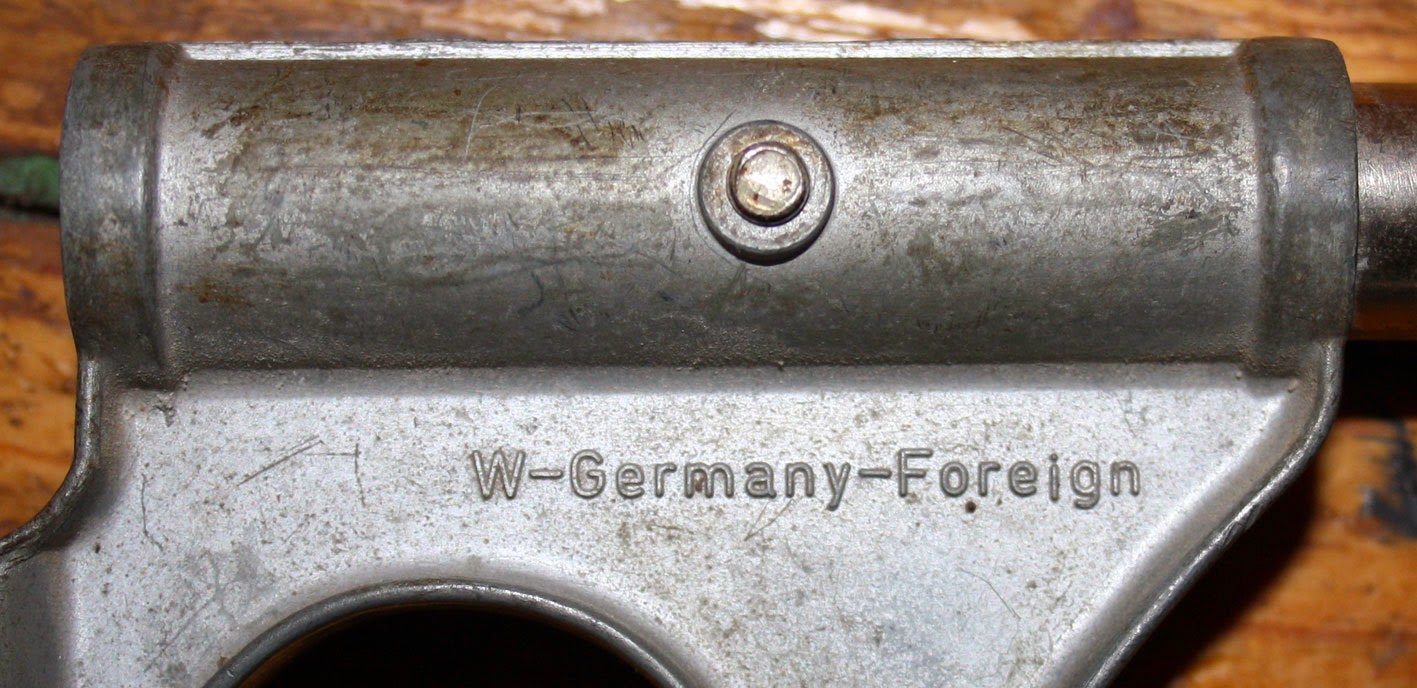
Update May 2018 A reader bought these pipe wrenches at an antique store. Though they are similar, one says Germany.
Mibro in a box, not a diamond and Germany stamped above it. Not West Germany so prewar?
Subscribe to:
Posts (Atom)