Thursday, July 12, 2018

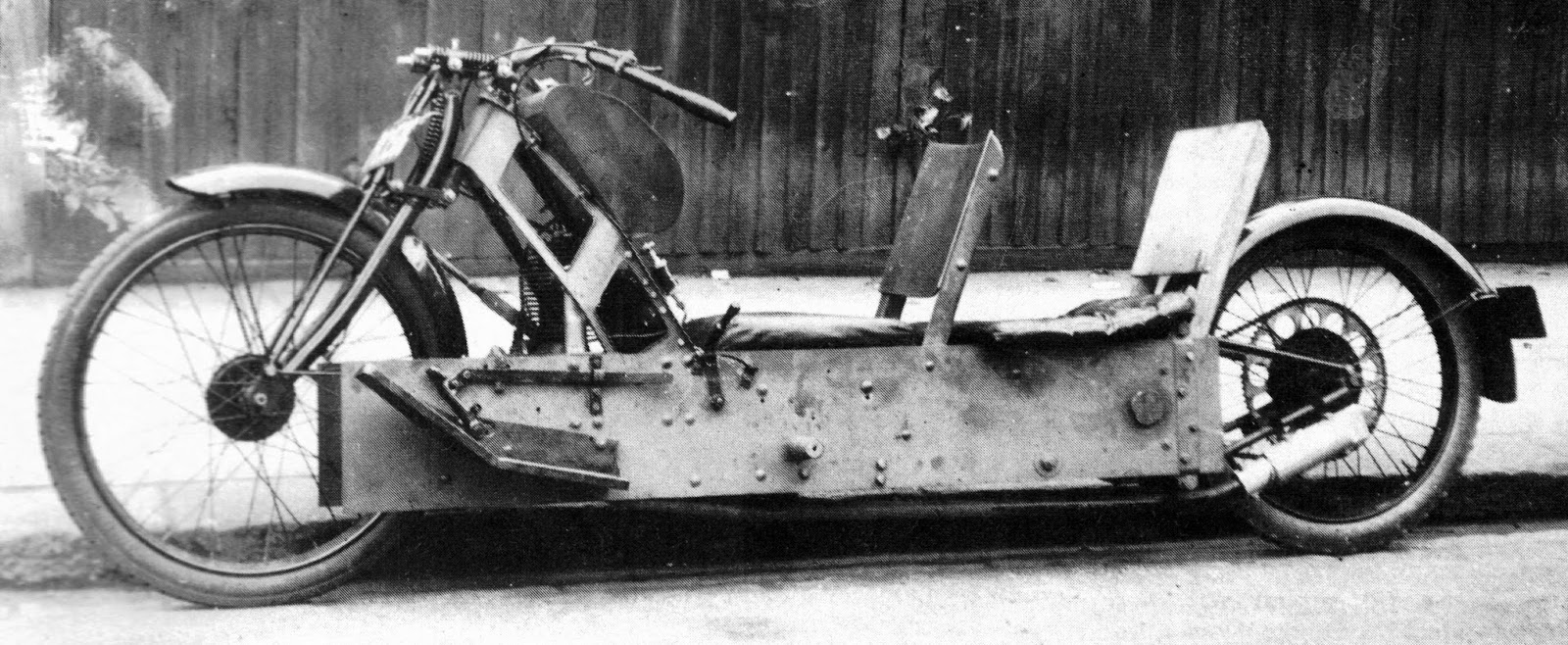
Redrup radial, 1920

March 1987 The Classic MotorCycle
The Redrup 309 cc 3 cylinder radial was produced as a stationary engine to power pumps, generators etc. The cast iron T-head engine had all the cylinders in a single plane with the rods acting on a single-throw crankshaft. The exhaust valves are located on the fan side of the engine. Apparently about 150 engines were made.
Of course it didn't take long for someone to see the possibility of a motorcycle powered with this unique engine. 
Thirty of these engines were used by the British Radial Co. who installed them in frames built by Chater-Lea. There can't be many left.


One of my vices is vises. H Boker hand vise

 Here is a very nice item by- once again- Henry Boker. A reader sent in this forged hand vice with a wooden- likely rosewood- handle. He says,
 "It was most likely used by a jeweler or watchmaker or similar trade.
The markings are H Boker and the name A. Crawford appears twice (was this the owner?) 
 The forged jaws are 1 1/4" wide, the tool is 9" in length. 
He estimates it dates to the mid 1800s which could be, as the company was in business from 1837 to 1970.


Wednesday, July 11, 2018

One millionth OMC outboard, Peterborough Ontario.

I should have probably posted this under the "We used to make things in this country" category but I think the OMC saga deserves its own post.
 From the Antique Boat museum in Clayton NY.  This motor commemorated the 1 millionth outboard motor produced at the Peterborough Ontario factory. The two cylinder unit was gold plated (though it looks more like silver) and a clear plexiglass cover was made up to display the inside workings. An identical unit was made up with the Evinrude name on it. 

Feet Forward!

No information at all on this mutant scooter. 

Bedalia Cycle car

Most cycle cars were made from motorcycle parts held together in the most spindly of ways. This one seems to be the exception, powered by a 20 hp V twin, shown here at a 1912 hill climb. But what's under all that bodywork?

Tuesday, July 10, 2018

Champion Sign


German motorcycle instruction model


Thanks to Cutaway Collector for this post.


This is a device and a category I was not even aware of, a motorcycle training aid used in Germany. Only a handful of these models were made in the early 1950’s by the VVR company, known for their driving school and education/ training models.
It’s about the same size as a carousel motorcycle, about 40 inches long. It has every function a real motorcycle has, ignition switch– the engine rotates, the clutch operates and the transmission shifts through the 3 gears. The hand and foot brake and the throttle operate as well as all the electrical components- switches operate the lights, horn and a brake light.
Inside the cutaway 2 stroke engine there is a little light showing the inside parts. The piston moves up and down in the cutaway cylinder and a little flashing light simulates the spark plug.
Other parts like the front and rear shock absorbers, the exhaust, carburetor, and battery have been cutaway to show their functions as well.
 The owner tells me it's for sale. He tells me it's been restored well and is nearly perfect. Wherever possible, new parts have been used in the restoration, including tires and new Formica in the right color on the base.
He says this is the only completely restored working model for sale in the past 40 years. It's not cheap in the $7500-8500 US range but what an addition to a collection!


Monday, July 9, 2018

Planes in formation, Mustangs

Long range fighter escort in Europe during WW2, the planes are equipped with drop tanks

Bakelite resins

In 1907 American-Belgian chemist Leo Baekeland discovered what became Bakelite while searching for a replacement for shellac. This was one of the first of the "plastics" to be developed. Though Bakelite was more commonly used as a molding compound mixed with sawdust and other fillers it also made for a good varnish replacement though this never became as commercially successful as the molded products.
The Bakelite Industry points to the accidental nature of many discoveries and inventions. Playdough and Post it notes are other examples of failed experiments that became successes in unrelated products. Also Teflon here.

Sunday, July 8, 2018

We used to make things in this country #294 Snow-Bug

On display at the Antique Boat Museum in Clayton NY.
 The Snow-Bug was built in Sudbury Ontario from the 1958 till 1977, predating Bombardier's soon to be popular Ski doo. The machine was developed by a steel worker named Howard Schrader and was made by the Noront Steel Company under the company name Original Equipment Manufacturing. It was built as a utility vehicle for hunters, trappers and prospectors, capable of running in deep snow at speeds of up to 30 mph. There were 3-500 were built per year, making it a rare machine indeed.
 More here.